Build practical urban competence through hands-on challenges that test navigation, problem-solving, and street smarts in real city scenarios.
Most of us navigate cities through screens, follow GPS arrows without thinking, and panic when technology fails. This quest strips away the digital crutches and forces you to engage with your urban environment like humans did for centuries—using observation, problem-solving, and actual skills.
You'll face eight practical challenges that range from analog navigation to basic urban repairs. Some will feel uncomfortable. That's the point. The scaffolder fixing the building at 6 AM doesn't check YouTube tutorials—he knows his tools. The delivery cyclist weaving through traffic isn't consulting Google Maps every block—she knows the streets. This quest builds that same practical confidence through direct experience.
Expect to get temporarily lost, ask strangers for help, and figure things out through trial and error. By the end, you'll handle city situations with less anxiety and more capability. You won't be an expert, but you'll be significantly more competent than the person who started this morning.
Why This Quest Matters
You'll handle the next dead phone, closed street, or transit disruption without the spike of helpless panic. By the end of this quest, you move through your city like someone who actually lives there—reading the environment, solving small problems, and trusting your built-in navigation instead of outsourcing everything to a glowing rectangle.
What You'll Experience
How to navigate cities using landmarks and spatial memory instead of GPS arrows
The actual walking pace and transit timing of your city without app estimates
Which urban plants are edible and where they grow in your neighborhood
How to read social cues and ask strangers for help effectively
Basic tool skills for solving minor problems in public spaces
What You'll Need
Top gear to make this quest great.
Pull it off
Compass with rotating bezel
Provides reliable directional reference when paper map navigation gets confusing. The rotating bezel lets you set and follow bearings, teaching you real navigation concepts instead of just following arrows. Unlike phone compasses, this works when batteries die and forces you to understand how direction actually works in your city.
Enables confident plant identification without internet lookup. Physical guides force you to learn distinguishing features and look-alikes instead of just image-matching on an app. Specific regional guides are more accurate than generic foraging apps that might show plants not in your area.
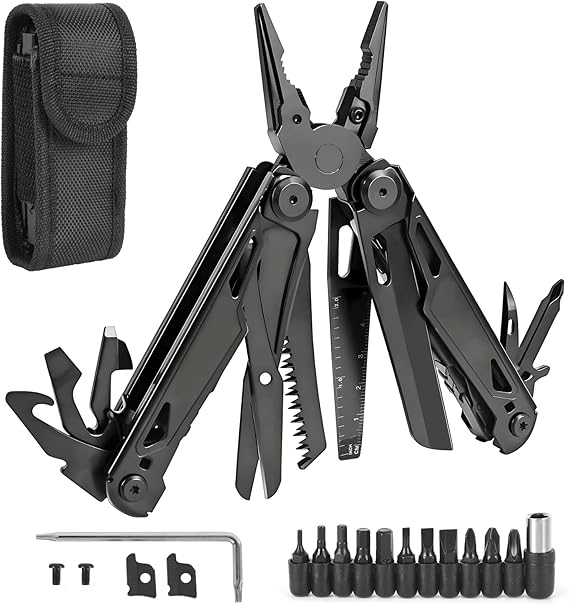
Transforms you from helpless observer to capable problem-solver. The pliers handle everything from tightening loose bolts to helping someone fix broken bag straps. Having real tools on you changes how you see urban challenges—from 'who can fix this' to 'I can probably handle this'. Choose one with spring-loaded pliers for easier one-handed use.
As an Amazon Associate I earn from qualifying purchases. Prices may change.
Step-by-Step Guide
1
Navigate with paper only
Buy or print a physical map of your city. Pick a destination 2-3 miles away requiring at least two turns. Phone goes into airplane mode. Navigate using only the paper map, street signs, and your spatial awareness—notice how often you want to check your phone and start reading landmark patterns instead.
💡 Pro Tips:
• Pay attention to sun position to maintain directional sense between map checks
• Building numbers progress logically; use them to confirm you're on the right block
2
Ride unfamiliar transit without apps
Take a bus or subway route you've never used before. Study the printed route maps at the station, ask transit workers or passengers for transfer help, and figure out the system analog-style. Time how long this actually takes to calibrate your expectations for screen-free travel.
💡 Pro Tips:
• Transit workers have seen every confused face—they're usually happy to help if you ask clearly
3
Identify three urban edibles
Locate three edible plants or trees in your city using a field guide—dandelions in parks, mulberry trees on residential streets, purslane in sidewalk cracks. Positive identification only; no harvesting. Note the specific locations for your mental city map.
4
Solve problems with your hands
Carry your multi-tool and spot three minor fixes in public spaces: loose bench screws, deflated bike tires, stuck zippers. Actually help with one if it's safe and appropriate. The skill is recognizing solvable problems, not walking past them.
💡 Pro Tips:
• People are often grateful for small helps—'I've got a screwdriver if that would help' works wonders
5
Ask five strangers for directions
Approach five different people with legitimate questions: best coffee nearby, fastest walking route to a landmark, where the hardware store is, library closing time. Practice reading who's approachable and communicating without screen-pointing. Write down three important phone numbers on paper for your wallet—friend, family, doctor. When your phone dies, you're not stranded.
💡 Pro Tips:
• People walking dogs or waiting at bus stops are usually more open to questions than those rushing with headphones
6
Build spatial awareness without screens
Throughout the day, estimate walking times before you travel, then check your accuracy—'that's probably 12 minutes away.' At three different points, stop and inventory without looking: What building are you facing? Which direction is north? What landmark did you pass two blocks ago? What's directly behind you?
💡 Pro Tips:
• Most people underestimate walking time by 30-40% until they calibrate through actual experience
Provides reliable directional reference when paper map navigation gets confusing. The rotating bezel lets you set and follow bearings, teaching you real navigation concepts instead of just following arrows. Unlike phone compasses, this works when batteries die and forces you to understand how direction actually works in your city.
Enables confident plant identification without internet lookup. Physical guides force you to learn distinguishing features and look-alikes instead of just image-matching on an app. Specific regional guides are more accurate than generic foraging apps that might show plants not in your area.
Regional plant identification guide focused on city-growing edible species with clear photos and safety warnings
Transforms you from helpless observer to capable problem-solver. The pliers handle everything from tightening loose bolts to helping someone fix broken bag straps. Having real tools on you changes how you see urban challenges—from 'who can fix this' to 'I can probably handle this'. Choose one with spring-loaded pliers for easier one-handed use.
Leatherman-style folding tool with needle-nose pliers, wire cutters, knife blade, screwdrivers, and bottle opener
Captures observations, phone numbers, and directions without pulling out your phone. The act of writing cements memory better than typing notes. Waterproof paper means you're not screwed if it rains. Use it to sketch quick maps, jot down building addresses, or note which street vendor has the best prices.
Write-in-the-rain paper notebook with pressure pencil or space pen
Grab a friend, a handful of dice and a stack of pocket cards, then let the roll decide what you do next. You write the options, the dice pick one, and you go. Each outing takes 15 to 30 minutes, and arguing with the dice is not allowed.
Your shoulders have been waiting all day for this.
Been at the screen so long your shoulders have opinions? Give yourself twenty minutes and a handful of tiny moves: shoulder rolls, a long look at the farthest thing you can see, a stretch over your own desk, and one wobbly minute balancing on one foot.
Your life stats are stagnant—time to grind IRL and unlock new abilities.
Transform gaming mechanics into real-world quests with achievement tracking, skill trees, and XP systems that make personal development feel like your favorite RPG.